Showing posts with label 1950s. Show all posts

Wednesday, September 28, 2016

Umberto D. (1952)

Today's film is Umberto D..  It follows the story of a pensioner who is struggling to make ends meet.  As the films opens, we see a huge gathering of old people protesting their meager pensions.  It seems that Umberto has the worst deal because he has debts that his pay simply can't cover.  It is interesting that none of the other people have debts like this.  Does Umberto have any kind of savings?

He gets so desperate that he tries to sell off his possessions, like his watch and books.  But he doesn't having many possessions to sell.  He doesn't even have his own place - he rents out a room at a boarding house.  His landlady has increased his rent and now demands back rent too.  And she wants it all or nothing.  He doesn't have that kind of money.

Umberto doesn't seem to have any family, but he does have his beloved dog, Flike.  No matter what happens, Flike is there for him.  Umberto goes to the hospital a bit for his sore throat, and his landlady purposefully left the door open so Flike would escape.  While Umberto was gone, the landlady took the liberty of redoing his room.  The workers not only ripped off most the wallpaper, they did a really bad job.  And they left gaping holes in the wall too.  These people are worse than my HOA.

So now Flike is gone, but Umberto finds him at the shelter.  We witness some more sad scenes such as a petowner that can't afford the fee to release his dog, dooming him to the gas chamber, as well as seeing the dogs being carted to their deaths.


Umberto does have one friend in this world, Maria the housekeeper.  She is very young and is now pregnant.  So she is at the beginning of her life and starting a new life, while Umberto is nearing the end of his.  They both really need to leave the toxic environment of the boarding house in order to have a better life.


Umberto gathers what little money he has and leaves the boarding house.  He can't bring himself to beg on the streets, so he contemplates suicide.  He tries to leave Flike at a kennel, but is displeased with the poor conditions so he changes his mind.  Later, he almost gets hit by a train, which really frightens Flike.   He'd rather play with his stick and toys, so the film ends with them playing together.  We don't know what else happens to them but we hope they find somewhere to live.  The film is mostly a commentary on society forgetting elderly people.  Today we have more programs to take care of them, and Adult Protective Services can help those who are truly in need.  We have come a long way since the 50's.  I will give this film a 7/10.

Friday, July 8, 2016

Europa '51 (1952)

Today's film is Europa '51, which seems like a decent drama, but overall feels a little silly.  It takes place in post-war Italy, where if a wealthy woman decides to give up her lifestyle and help the poor, she must be crazy.  The idea is if you took a saint like character and put her into a modern world, what would happen to her?

Irene is the wife of an ambassador and used to living life in luxury.  She often throws dinner parties and entertains guests.  However, her son is needy and clingy and is desperate for her attention.  This would be more understandable if he was young, but he's twelve years old.  There's a time for being with kids and a time for being with adults.  Spend the afternoon with your son and then the evening with the adults.  I can fully understand not wanting to have him at the dinner party.  Last time I brought my daughter to a nice restaurant, she ran around like an animal and stole a lady's eyeglasses.

So, her son, very upset at being ignored for five whole minutes, jumps down the stairs in an effort to injure/kill himself.  He breaks a few bones and spends the night in the hospital, but he should be fine.  Irene is feeling quite guilty at his plight and vows to spend much more time with him.  However, he dies unexpectedly from a blood clot sustained from his injuries.  So, Irene falls into a deep depression and doesn't leave her room for a while.  When she does, she decides to help others in need.


Her help gradually increases from simply helping to pay for medication to helping the actual people in the neighborhood.  What would really help is if these people could find jobs with decent wages, the same problem we have here today.  A handsome male friend of hers, her husband's cousin Andrea pushes the idea of social radicalism to make a better society.  Of course they have to throw communism in there because it's a 50s movie.  Irene's husband is upset that she's not around and believes that she is cheating on him.   Here's a radical idea: Tell. your. husband. what. you. are. doing.

That would have solved everything.  Just tell him you're depressed and helping poor people makes you feel better.  Spending money on medicine and food for children instead of on dinner parties.  Eventually she gets thrown into the crazy house.  They don't understand that someone doesn't need to be a part of a religious or political group in order to help the underserved in their communities.  A group of people that she's helped rally outside her window, but she's trapped inside.

This movie was okay, but it just seemed like a mouthpiece for various political ideas.  The characters are too unrealistic and there is no actual reason for her to be committed.  The 50s justice system in movies never makes sense.  The film shows the contrast between the wealthy Italians and the poor of society without offering any true solution.  I will give it a 5/10.

Saturday, June 25, 2016

The Bridge on the River Kwai (1957)

Today's film is The Bridge on the River Kwai, which focuses on a Japanese prison camp during WWII.  A huge troop of British soldiers and officers have been captured, and the director of the camp forces them to build a bridge for the Japanese army.  There's also an American who has been there for some time, but more on him later.

The main officer, Col. Nicholson, plays only by the rules and claims he and the other officers shouldn't be doing manual labor like working on a bridge.  The director, Saito, doesn't care about no stupid Geneva convention and wants as many people as possible working.  This becomes a battle of stubbornness between the two, and we know how stubborn men can be.  Eventually, Nicholson wins and the British set out to build a really good bridge.

Now this bridge becomes a source of British pride for Col Nicholson and he gets really hardcore about it.  He refuses to sabotage any of it, and makes his soldiers build it the best they can, so years later when the war is over, they can all be remembered for this super fantastic bridge of awesome.  That's in the middle of nowhere in a jungle.  They even erect a fancy plaque to commemorate the bridge. Really.


Remember the American dude from the beginning?  Well he escapes and with the help of local villagers, makes a miraculous recovery.  The navy wants him to go back and lead them on a dangerous mission through the jungle - to blow up the bridge on the River Kwai.  He really doesn't want to.  He spent a long time in the awful prison camp, suffered, and saw many people die.  He is starting to get over what he went through and they are forcing him to go back.  He agrees to go with them.  It takes a while but they do make it to the bridge.

They set up the charges to blow up the bridge, but of course Col Nicholson spots them and runs down to investigate.  He really gets in their way of blowing up the bridge, and causes the death of the soldiers responsible for blowing it up.  The soldiers tell him what the mission is about and he realizes he let his personal pride ruin what they were doing.  He falls on the plunger himself and blow up the bridge.  Now when he is hit he lands over there <----  and then falls on the plunger which is over here ------>.   Well that is remarkably convenient.  Overall it was a very enjoyable film.  I will give it a 9/10.

Wednesday, June 1, 2016

The Greatest Show on Earth (1952)

Today's film is The Greatest Show on Earth, but it's definitely not the greatest movie on earth.  Why are Charlton Heston movies so long?  I remember watching this on tv when I was little, but all I remembered was the train crash, so I thought I should watch the whole thing.  So this marks the 50th best picture film I have ever seen.

I wouldn't call this a best picture, but compared to the other films nominated? Probably yeah.  There was like Ivanhoe and Moulin Rouge and stuff, so I can see that a super exciting circus picture would win it.  It's more of like an almost 3 hour long commercial for Barnum and Bailey circus.  The worst part was Betty Hutton's acting by a long shot.  They have scenes showing each of the acts, the animals, and a whole section about putting the tent up. They make sure to mention the tent's fireproof quality because just a few years before, a circus tent burned to the ground, killing over 100 people.  And no one has to worry about racketeers or thieving carnies at the circus, because they will get thrown in the mud.  No, literally they get thrown in the mud.

The main reason why I really don't like the circus and I'll never take my kids is because of the animals.  Animals are not meant to be locked in cages and only let out to perform for people.  That's a horrible way to live.  They are portrayed positively in this film, and an elephant trainer even uses her elephant to lift off a broken rail off the boss, when machinery could not.  Barnum and Bailey actually stopped using elephants in its acts this year, but is it too little, too late?


There's lots of subplots in this movie and there has to be because circuses take a lot of people to run.  The boss, Brad (Charlton Heston) hires a popular new act to ensure a full season.  The act is Sebastian, a hot either French or Italian, I cant tell, aerial act.  This forces Brad's girlfriend, also an aerial artist, out of the center ring which devastates her.

My little sister is actually an aerial artist for the circus which is one reason why I find circuses so interesting.  Aerial artists (they hate being called trapeze artists) take what they do really seriously and often feel invincible doing it.  That's why Holly used the wrong rope to do her spins and why Sebastian cut away his net.  They don't see the danger in what they're doing.

Another thing is they gave Buttons the clown wayyy too much screentime.  He's like in every scene.  And the big reveal is that he's actually a murderer.  Well of course he's a murderer, he's a clown.  I didn't need to see any of the movie to tell you that.

This may not be the best acted movie ever, but you don't go to the circus for the acting.  You go because it's exciting.  And there's a lot going on everywhere you look. And this film achieved that so I will give it an 8/10.

Thursday, April 14, 2016

The Earrings of Madame de...(1953)

Today's film is The Earrings of Madame de... .  The main lessons we take from this are don't cheat on your spouse and don't lie either.

Madame de's first name is Louise, and her last name is never revealed.  So we'll just call her Louise.  She's very rich and pretty, but at the same time greedy and selfish and a shopaholic as well looking at her closet.  She's amassed quite a bit of shopping debt so she decides to pawn her earrings.  Everyone at some point in time has had to pawn something to pay off a bill.  The struggle is real.  However, the earrings she chooses were a wedding present from her husband, even though she's not fond of the style.

The whole problem comes from Louise's inability to tell the truth.  Her husband is obviously wealthy, but has no idea of what debt she may owe or why.  Well we know why - she shops too much but he doesn't know that.  It's not like they had online bank receipts back then.  She makes this huge show about losing her earrings at a theatre so much that it makes the news.  But her lie is revealed quite quickly.  Now that her husband has the earrings, he gives them to his mistress who is traveling to Constantinople.

Let's talk about how awful Louise and her husband's relationship really is.  They not only sleep in separate beds, they're straight up sleeping in separate rooms.  He had a mistress, and she's sweet on a hot Italian diplomat named Donati.  And they have no problem constantly lying to one another.


One of the reasons Louise falls for Donati is because he dances with her at every social gathering.  Certain husbands refuse to dance with their wives and it can be frustrating.  We don't care if you "don't have rhythm", if you don't dance with us we'll find someone who will.

Donati purchases the diamond earrings and gives them to Louise, not knowing they were originally hers.  This makes her husband hella mad.

Louise's husband becomes jealous of her love interest and challenges him to a duel.  This isn't fair because he's a general with combat training and a duel isn't going to be a challenge.  So, her husband thinks its okay to have a mistress but his wife can't even look at another man?  Typical men.  He shoots Donati and kills him with one shot.  Meanwhile, Louise tries to stop them but she is too late.  I think the film is very well shot, and the costumes are beautiful.  I will give it an 8/10.

Friday, March 4, 2016

Mon Oncle (1958)

Today's film is Mon Oncle (My Uncle).  It is another film featuring Jacques Tati's character Mr. Hulot.  The central theme of all Jacques Tati's film is that modern life is too complicated and frustrating.  The modern world is also cold and impersonal, too plasticky.

This film focuses on Mr. Hulot, and the fact he seems to have no job.  We also never see him eat and he always stays clean.  Is Mr. Hulot a robot?  Is that why he hardly talks?

Mr. Hulot's sister and brother-in-law may see him as a loser, but their son, Gerard is very fond of him, because he's a fun guy.  Gerard lives in a sterile, modern house that feels boring, and his fun uncle is a break from that.

 Mr. Hulot's sister, Mrs. Arpel, has a mission to get her brother a job as she feels it will be good for him.  I think Mr. Hulot's main problem is that he has no spatial awareness. That could be a flaw in his programming.


Gerard and his friends like to pull pranks on unsuspecting adults and fool them.  Kids back then were just like kids are today.  People like to think kids today are bad because society is worse, or "rap culture" makes them bad, but these kids in the film are no different.  Kids throughout history have always been little shits.

Their pranks remind me of my husband's favorite game.  There is a place here that you can sample different sodas.  One is a terribly bitter soda.  It's actually meant to be a palate cleanser, not a soda to gulp as a snack.  His favorite pasttime is tricking unsuspecting people to take a huge sip of this soda.  Their faces are priceless after drinking it.

One thing that confuses me about this film is the weather.  Some people are wearing big coats, while others are wearing sundresses.  Well is it hot or cold in France? I don't know.

Shout out to Mr. Arpel for doing everything he can to secure employment for his brother-in-law.  He doesn't do it for himself, and he definitely doesn't do it for Hulot, who he sees as a constant fuck-up.  He does it because he knows it will make his wife happy, and he loves his wife very much.

Mr. Hulot's lack of spatial awareness in a factory where people and machines depend on him is a recipe for disaster.  He can't pay attention to anything and climbs on things like a monkey.  Then, he single-handedly destroys about 300 feet of plastic tubing, which can't be cheap.

Mr. Arpel doesn't give up and offers him job after job.  Millions of jobless college graduates dream of being in Hulot's position.  But instead of being grateful, he just continues to fuck everything up.  Finally, Mr. Arpel has the great idea to ship him somewhere else, so the last scene is him dropping off Hulot at the airport.

This film is amusing, but it's not hilarious.  I will give it a 7/10.


Monday, February 22, 2016

Ugetsu monogatari (Ghost Story) (1953)

Today's film is Ugetsu monogatari, which means "ghost story".  I do love a good ghost story.  Ghosts can be benevolent or have evil intentions, basically no different than living people.

The film takes place in feudal Japan; a time of shogun and samurai, a time of constant wars.  Caught in the middle of this is a family that makes pottery.  The husband's name is Genjuro and he hopes to make a fortune selling in the city.  Meanwhile, their neighbor Tobei wants to be a samurai despite not being born into the class nor having any combat training or armor.  Their wives warn them against their ambitions.

While in the city, Genjuro encounters a beautiful woman with serious eyebrow game and her old nurse.   She loves his beautiful pottery and orders it to be taken to her mansion.  Lots of weird stuff warn us that this is not a good idea.  The woman is Lady Wakasa and she is the last surviving member of her family.

Genjuro falls under Lady Wakasa's spell and stays with her despite being married.  Tobei through sheer luck does become a samurai, but loses his fortune just as quickly.  While Genjuro is busy cheating, his wife and child try to make their way back home.  His wife is robbed and killed by passing soldiers, but her little boy escapes.


When I studied Drama History, I actually wrote my term paper on Noh drama, which is a type of theatre performance.  Lady Wakasa's mask-like makeup and slow, deliberate movements are exactly what you would see in a Noh drama.  These plays often focus on kami, or spirits, which is another way of foretelling us that Lady Wakasa is not of this world.

Genjuro finally comes clean to Lady Wakasa and tells him that he's already married and escapes.  But he learns the truth, that everything was an illusion!  Even the mansion they were staying in was actually burned down!

Genjuro returns home to his wife and child, but we know that his wife is not really there.  She returned one last time to see him and make sure her son was safe.  The next day, Genjuro learns that she was killed while he was busy cheating, and he feels bad.  Tobei and his wife who are back to their normal lives too, learn that having too much ambition and being greedy can ruin you.  I will give this film an 8/10.

Thursday, February 18, 2016

Some Like it Hot (1959)

Today's film is Some Like it Hot.  It's got Marilyn Monroe in it!  Yeah let's watch!


The two most funniest things in the universe:


  1. Farts
  2. Men dressed up as women

So, these two male musicians, Joe and Jerry, witness a mob hit, and not just any mob hit, but the famous St. Valentine's Day Massacre, in which 8 people were murdered.  They see a group of female musicians, and run away with them as to avoid being made.


There's men dressed up as women, men dressed up pretending to be different men, it all gets crazy.  Is no one who they say they really are?  Joe tries his best to woo Marilyn Monroe, which can't be that hard, I mean she's Marilyn Monroe. Come on.  Meanwhile, Jerry as a woman is fancied by a millionaire.  He tries everything he can to keep him away without revealing himself, but in the end he comes clean and admits he's really a man in disguise.  The millionaire doesn't care about that and he and Jerry are still married to this day.

If this movie was remade today, it would star Adam Sandler and Kevin James and my husband would watch it every Friday.  10/10 would watch again.


Wednesday, January 20, 2016

La Strada (1954)

Today's film is La Strada, a film that doesn't end well for the characters. I wonder if this film has to do with Italy itself after it lost WWII.  I tried looking up "La Strada" and all I got was directions to a local Italian restaurant. :(

It starts off with the death of Zampano the Strongman's assistant, Rosa.  He goes to her mother's house and asks to purchase her other daughter, Rosa's sister, Gelsomina.  Gelsomina is a simple, naive person and is forced to go with him as his new assistant.

Zampano and Gelsomina travel across the country as vaudeville performers.  Zampano is a strongman who has one stale act, while she learns to play instruments and entertain as a clown.  He doesn't treat her well, beats her, and sleeps around with any woman who says hello to him.


They are invited to work as part of a circus, but that doesn't go well either.  A high-wire act known as "The Fool" loves to taunt Zampano, and the angrier he gets, the funnier it seems.  Eventually, Zampano pulls a knife on him and is sent to jail.  The circus fires both of the men, and ask Gelsomina to stay with them.  But she refuses and goes to the jail to pick up Zampano.  The Fool also asks her to go with him as part of his show, and she refuses as well.  Later, she meets a nun who almost gets her to stay, but she will still not leave him.  Maybe she is more afraid of the unknown than she is afraid of staying with him.  She is a very simple person and doesn't know any better.

Later, Zampano and Gelsomina come across The Fool, who is changing a tire by the roadside.  This prompts Zampano to kill him, which devastates her.  He abandons Gelsomina while she is sleeping and drives off.  She cannot handle both the death of someone who was actually nice to her and her abandonment.

A few years later, Zampano learns what happened to her.  A woman tells her that her family found her on the beach, but she never spoke and eventually wasted away and died.  Did he learn anything from this?  Probably not.  I will give this film an 8/10.

Sunday, December 27, 2015

Les vacances de Monsieur Hulot (M. Hulot's Holiday) (1953)

Today's film is M. Hulot's Holiday.  It is a good, simple film.

So it takes place during vacation season when the whole country flocks to the seaside for relaxation.  A lot of the scenes, especially in the beginning, reminded me of the movie Airplane.  Most of the gags are visual in nature.  There is barely any talking at all.  In fact, there's not really a story or plot, it's just a bunch of people, including M. Hulot who are taking a vacation.


Most of the humor comes from M. Hulot's carelessness or lack of thought.  He leaves the door open while getting his luggage, and this causes the whole lobby to be windy.  Or, he doesn't put up the brakes while changing his tire, so his car rolls down the hill.

Other than that, a lot of the people are still mentally at work and can't relax on vacation.  We see that even worse today.  Work is work, vacation is vacation.  In this way this film will always be relevant.
I will give it an 8/10.

Must be nice to live in a time where no one would
associate your hair with Princess Leia.

Sunday, December 20, 2015

The 400 Blows (Les quatres cents coups) (1959)

Today’s film is Les quatres cents coups (The 400 Blows).  The title actually comes from a French saying meaning “to raise hell” so it doesn’t really have anything to do with “blows”.  The film feels very modern and relevant, and I think a lot of people can relate to it.
Even though this film was set in current times, for us it’s the past and provides us a unique window to see what everyday life was like.  I don’t know what school was like in the 18thcentury, but I know what it was like in the 1950s because I am watching it right now.   It is amazing how it is exactly like school in the 1990s.  Except for now, in our modern age, playing hooky feels a little different.

One of the students is Doinel, who is not a villain, but always seen as a troublemaker by his harsh teacher and his parents.   He has trouble paying attention.  He might have ADD or he might not be challenged enough and is bored.  I have Autism and was always at odds with school personnel.  Then when someone explained my condition, they automatically feel sorry for me.  School can be overwhelming and boring at the same time.  But people like us are always dismissed as troublemakers.
Then comes Doinel’s mom, who is the source of all his problems.  He knows that she never even wanted him to begin with, and he can thank his grandmother for convincing her to keep him.  That must weigh heavily on him.  He catches her with another man, but cannot tell his stepfather because it would reveal that he was skipping school that day. 

Wanting to tell your dad that your mom is cheating on him, but it
would reveal you were playing hooky.

Later, he is caught trying to return a stolen typewriter and sent to juvie.  He sees the ocean and makes a break for it.  As he runs toward the freedom of the beach, the film freezes over his face.  But his story is far from over.  Just you wait, Doinel.  Soon you will have kids of your own and your mom will reappear out of nowhere.  Nowhere!! Because she wants to "play Grandma" and she will have the audacity to tell you how to raise your children even though she knows fuckall about children in general.  Man, this movie is so realistic that it's painful.  I give it a 10/10 this movie excels on all levels.

Friday, December 11, 2015

Pather Panchali (Song of the Little Road) (1955)

Today's film is Pather Panchali.  It is part of a series, so don't expect any closure at the end.

So here we have a family living in India, and they are barely getting by.  The father is a writer, poet, and priest, who is artistic but doesn't have much money sense.  He even gave away his family's orchard to settle his brother's debts.  Did he know exactly how much his brother owed vs. how much the orchard was worth?  Was there anything on paper proving this?  No probably not.

To get by and put food on the table for her two children, the mother, Sarbojaya, sells what little possessions she has, including her wedding dishes.  The struggle is real.  Interestingly, this film was made on a tiny budget, and the director and his wife pawned their possessions to help fund it.


Her daughter, Durga, often steals from the orchard, but it did used to be her orchard, so I don't think she knows what she is doing is wrong.  Eventually, her kleptomania evolves to steal non-food items as well.  What's worse is that her family defended her the entire time and she actually did steal the jewelry.  There's like a total of ten people in her village, where was she planning on wearing it?

Durga has a little brother named Apu, who is sent to school, but it's not a very good school from the looks of it.    Most of the film centers around the two.  Even though they don't have much, they share simple joys every day.  Durga is a great example of a big sister, being a leader, motherly, but sometimes teasing too.  Got to keep the younger siblings in line.

Their dad decides to leave town to find work, and it takes a toll on the family, especially his wife.  After playing in the rain, Durga catches a cold, which develops into a high fever and she passes away.  Soon after, her dad returns home with gifts, but no one cares because Durga is gone.  The family decides to leave their ancestral home to find a new life elsewhere.

It is refreshing to see an Indian film without a ton of singing.  Also, the whole life in poverty theme is pretty universal.  I will give it a 7/10.

Friday, November 13, 2015

Letyat zhuravli (The Cranes are Flying) (1957)

Today's film is The Cranes are Flying, which focuses on Russian families during World War II.  It mainly follows one woman and her family.  This is Veronika, who is in love with Boris and plans to marry him.  Boris's cousin, Mark, is also in love with Veronika and is a total creeper whenever he's around her.

Boris is smart and talented enough to avoid the draft, but he volunteers to serve his country.  Mark somehow escapes the draft, but we will learn how later.  In the scene where the soldiers are leaving for war, we see all of the families saying goodbye. There are new mothers holding tiny babies, looking very worried, as well as old grandparents who have seen war before. Most of the films like this would be propaganda about how great it is to serve, but we really see that this may be the last day any of them see their families.

Next comes the German bombings that destroy everything.  It's easy to see the Soviet Union as the faceless monster of communism, but it had real people who lived there, and millions of people died during the war.  Veronika loses her parents when their house is hit, and Boris's family invites her to stay with them.  During another air raid, Veronika hides out with Mark, and he takes advantage of the fact that no one is around and rapes her, then manages to shame her into marrying him.  We knew he was a bad guy creeper the whole time.  Afterwards, he is a terrible husband, ignoring her to play music and party.  Eventually we learn that Mark bribed someone to escape the draft and he is later kicked out of his marriage and his house.


Veronika works at a hospital as a nurse and sees many injured soldiers.  After one soldier has a breakdown because his girlfriend left him, she leaves to go outside.  She never meant to hurt Boris and she's stuck with someone else.  Meanwhile, Boris dies while trying to save another soldier, but she doesn't find out until the war is over.  At first she doesn't believe it, because he's listed as missing. She decides to wait until his friend, who volunteered with him, returns.  Unfortunately, he really is dead.  Meanwhile, she takes care of a child missing his parents, who more than likely were killed in an air raid.

When the war is over, the surviving soldiers return.  Boris's friend gives her a bouquet of flowers to show her he's sorry for her loss and tells everyone a speech about how they will never forget those who served.  Meanwhile, Veronika takes out the flowers from the bouquet and hands them out to others.  The film serves as a remembrance of all the Soviet soldiers and citizens who died in World War II.  It also shows how people grow up and change by war.  Veronika went from a goofy girl who called herself "Squirrel" to a mature nurse who takes in a child and stands up to her loser husband and kicks him out.  I will give this film an 8/10.

Tuesday, November 10, 2015

Ivan Groznyy part two (1958)

So the first Ivan Groznyy came out in 1944 and the second part didn't come out until 1958.  That's a long time to wait for a sequel!

So there's more government problems and more stuff to worry about for Ivan in this film.  We also learn more about his past, that his mother was poisoned by the boyars.  We know this because she shouts poison really loudly.  Thanks for the exposition, Ivan's mom.

Ivan also learns that Big hat lady was responsible for poisoning his beloved wife, and vows revenge.  Big hat lady wants her son to rule as tsar.  Or, since he's a giant man child, she would do most of the actual decision making.

Ivan proves he's a pretty clever guy.  He invites Vladimir, the man-child over to watch a play and drink with him.  Vladimir tells him about certain people wanting his reign to end, so Ivan gives him his crown and lets him play pretend tsar for awhile.  While doing so, an assassin kills him, thinking that he's the real tsar.  His mom comes in joyous that Ivan has been destroyed, only to realize her own son was killed.  Ivan announces that he won't punish the assassin, for he has killed his enemy.  And that's it, it's a really short film.

Ivan does do some talk about his power being derived and strengthened by the people, but we know that was really Stalin talking.  This was less like a silent film than the first, but it still wasn't any better.  I will give it a 5/10.

Tuesday, August 18, 2015

Nuit et brouillard (Night and Fog) (1955)

Today's film is a documentary called Night and Fog.  It shows the history and aftermath of the Holocaust.  This film manages to deliver in 30 minutes what other documentaries take 9 hours to achieve.

The film alternates between the color film of the present, and black and white film of the past.  It shows how the camps were built, and what happened in those camps.  The man providing the voiceover commentary actually was a prisoner inside one of those camps.

One interesting thing is that this documentary doesn't provide any personal sob stories.  Over 9 million people died and we can't hear all of their stories.  The film shows the gas chambers, ovens, and piles of bodies.  When the Allies came in to liberate the camps, they didn't know anyone's story.  All they saw were the piles and piles of dead bodies and that was enough.  With this film we see exactly what they saw.  So it's like going back in time with them.

The film says that the prisoners were distinguished by their uniform, but doesn't go much further into it.  That's because the filmmakers wanted us to know that it was more than just Jews that were killed.  The filmmakers also said that this was an allegory for the French invasion of Algeria and they didn't want to favor any particular race.  That's why some of the camps they filmed were in France.  I remember that we watched Schindler's List in school, and I wish they would make students watch this film too.  It was very informative and emotional.  I will give it a 9/10.

Wednesday, August 12, 2015

A Star is Born (1954)

Today's film is A Star is Born.  There is a lot of singing.  But it's all done by one person, Judy Garland.  Like she has to sing every song.  There's too much singing.

I watched the restored version, which is longer than the theatrical version.  The film itself had been lost, but the soundtrack was found, so they put still images where the film would be.  It made a lot more sense with the extra stuff put in.


This was one of Judy Garland's last films.  That's probably why she put such effort into singing everything.  Her character, Esther/Vicki's husband, Norman, is an alcoholic.  Judy in real life suffered from addiction and eventually passed away from an overdose.  There is a deeper theme of addiction and depression in this film that is slightly hidden by all the happy singing. So I feel that this was very personal project for her.  It is pretty dark that way.  The film dragged on a bit, but it was okay.  I will give it a 5/10.

Thursday, July 30, 2015

Paths of Glory (1957)

This week is the 101st anniversary of the beginning of World War I.  So today we are watching Paths of Glory.  In the first years of the war, the soldiers engaged in trench warfare, meaning they dug trenches and shot each other over an area called "no man's land" and didn't really accomplish anything except mass casualties.  The movie takes place during this time.

In France, the soldiers are busily fighting against the Germans, but remember everyone's still in the trenches.  General Mireau of the French army has been promised a promotion if his army can take over Ant Hill, which is controlled by the Germans.  Of course he says they could do it in one day without any backup.  He goes to order the colonel of the troops, Col. Dax to launch the attack.  We also learn Colonel Dax, played by Kirk Douglas, was an excellent criminal defense lawyer before the war.  Will this knowledge come in handy?

So, the next day, the French army storms across the no man's land to take over the hill and get obliterated.  Of course they did, they're French. They should be used to losing battles.  But apparently not.  Half of them can't even leave the trench because they're being beaten so bad.  General Mireau orders another group to fire upon the trenches, but they refuse to shoot their own men.  This just makes him even madder.

General Mireau tells them to pick out three men and have them tried for cowardice.  This is where Col. Dax being a lawyer comes into play.  He tries his best, but the trial is really just for show.  So the men are sentenced to die.  Later, Dax tells the higher up, General Broulard, that General Mireau threatened to fire upon his own troops and he's like whaaa.  But, he's not going to overturn the conviction, because that would be like admitting that the army was wrong, and he's not going to do that.


One thing that lets you know this took place long ago is the fact they were in trouble for cowardice.  In the beginning, General Mireau yells at a traumatized soldier and tells him there is no such thing as shellshock.  Well, there is, and now it is called post traumatic stress disorder (PTSD) and it still affects many people today, both soldiers and civilians.  Men are supposed to be brave and strong and not afraid of anything.  I feel bad for them because they couldn't even ask for help because even admitting they need help would be admitting they were a "coward".  In real life, thousands of men were tried for desertion and cowardice.  There are more steps taken to take care of soldiers affected by PTSD but even 100 years later, we still have a long way to go.

General Broulard offers Dax General Mireau's position, but he refuses it.  He goes back to see his troops inside a cafe gawking at a German woman onstage and he's like oh boy here we go.  But, she starts singing the song "The faithful Hussar (soldier)" in German and all the French soldiers start singing along with her.  For a moment, they're not German or French people who are enemies, they're just people.  This woman is supposed to be the enemy but she's never hurt anyone ever, meanwhile their own General just killed three of their friends for his own reputation.  Colonel Dax watches them and decides to wait longer before sending them back out to be killed in the trenches.  I will give this film an 8/10.

Friday, June 19, 2015

High Noon (1952)

For the past few weeks, I've been watching black and white films.  This makes my husband mad.  I don't expect him to watch everything or even like any film I watch.  Sometimes I don't even like the films I watch.  But he gets so mad he leaves the room.  So I finally asked him why he leaves.

It turns out he doesn't like the fact he has never seen a non-white person on the screen in a black and white film (he's Native American or more accurately First Nation since his tribe's from Canada).  So I told him that the reason this is is because we show up in film (because of the higher contrast between white skin and grey picture). If a non-white person like him was to be filmed in black and white, they'd appear like an unlocked character in a video game.
What my husband might look like
in a black and white film
 
The best part about this is that he totally believes me and is now ranting to anyone who will listen about the injustice of this.  I told him that is why color film was invented and also why there are no old photos of his family.  I suppose one day he will find out the truth but I'm not going to tell him. It is too funny.


Today's film is High Noon, which is obviously a black and white film.  It starts off with a really old guy sheriff marrying a young beautiful Quaker woman, Amy.  Already the believability of this film is gone! Why would someone who opposes gun use and violence marry a Wild West sheriff? Makes no sense.    Also I don't want to see them make out because he is old.  I don't even care if they were dating in real life because I don't want to see it.  

Then, someone that he sent to jail long ago has been released and is returning to town to kill him.  The old sheriff tries to round up a posse but no one cares.  This part is actually realistic.  The bad guy isn't trying to kill me, actually he hasn't done anything wrong to me or my family at all, so why should I care?

We have no idea how the sheriff or Amy met, but even more mysterious - who is Mrs. Ramirez?  We find out that she owns the hotel and stuff, and she hasn't spoken to the sheriff in a year.  Why? Did they used to go out? Who broke it off?  So many questions.  Mrs. Ramirez does the sensible thing and leaves town when the bad guys come.  Amy changes her mind at the last minute and goes back to town to find her husband.  She originally was going to leave him if he stayed to gunfight or whatever so that proves how loyal she is.  He's a sheriff.  He uses guns.  Get over it.  Since no one else will help him, she shoots and kills one of the bad guys because of course that makes sense.

John Wayne called this film un-American, but he was a racist who hated Native Americans so fuck him. I didn't see anything particularly anti-American about this film.  It has some allegory to communism but everything in the 1950's was about communism.  It's a nice film if you like westerns.  I will give this film a 6/10.


Monday, May 18, 2015

Ben-Hur (1959)

Today's film is Ben-Hur.  This film had a huge budget, and they used every bit of it.  Authentic costumes, props, thousands of extras, no expense was spared and that makes one awesome movie. However, some of the editing cuts were pretty bad, but then again it was made in the '50s.

Judah Ben-Hur (played by Charlton Heston) is a Judean prince whose best friend is a Roman, Messala.  Messala (played by Stephan Boyd) is power hungry, and when an important Roman figure is killed by Ben-Hur's poorly maintained roof, he uses this to his advantage.  Instead of forgiving him, he makes an example out of him and sends him off into slavery, and also imprisons his mother and sister.

Ben-Hur spends the next three years as a galley slave, rowing the Roman boats.  He catches the attention of a Roman Consul, Quintus Arrius, and later saves his life when the boat sinks.  Arrius is so grateful that he petitions for his freedom and later adopts him as his son and teaches him how to drive chariots.  However, Ben-Hur is still consumed by his quest for revenge against Messala and he returns to his hometown.

Now here comes the part we've all been waiting for: the chariot race.  Ben-Hur meets a sheik that owns beautiful white horses and asks him to run the big race.  Once he finds out Messala is running too, he agrees.  Because the race is so dangerous, either one could die while doing it.  So now he can kill Messala in a semi-legal way, which somehow makes it better.  Messala may be an ass, but he hasn't killed anyone.  Meanwhile, Ben-Hur killed two guards while escaping prison, and then more people while the boat was sinking.


The chariot race scene itself had 15,000 extras.  The little town my husband lived in had 6,000 people living it it.  Ok?  So 6000 people in town and then over twice as many were in one scene in a movie, that's how big this scene was.  That's amazing.  The race was exciting, and Messala pulled some straight James Bond shit with his sharp wheels.  However, Ben-Hur won, which is not surprising because it is his movie.  Messala is dying from his injuries but Ben-Hur doesn't even care.  Was killing him really worth it?  Did it really change anything?

Meanwhile, he finds out that his imprisoned mother and sister contracted leprosy.  A remedy wasn't available back then.  Fun fact: leprosy takes about 3-5 years before symptoms appear.  They were imprisoned for 3 years, meaning they could have caught it long before they were imprisoned.  So, Ben-Hur killed the bad guy and will marry his slave's hot daughter (who is a terrible actress and took away from the scenes) but what will happen to his mother and sister?

One of my lit teachers told us about "deus ex machina" - basically, the writer can't end the story (like the plot has come to a standstill or they face an impossible problem) so something unexpected happens to solve the problem almost by magic.  It comes from Greek theater where a god would appear at the end to fix everything.  Well, this is how they solved the leprosy problem - Jesus, who by now has had a few cameos, uses his +5 god magic to heal them.  Wow.  Did not see that coming.  So the moral of the story is, if one of your friends betrays you, make sure you kill enough people to survive, and kill him too, then Jesus will heal your family.  Cause that's what happened.

Since so much effort was put into this movie, it really is a spectacle.  I will give it an 8/10.


Sunday, April 5, 2015

North by Northwest (1959)

Today's film is North by Northwest, a film so great Kayne West named his daughter after it.  There is so much happening in this film! A lot of it went by in a blur for me. Every minute something new is happening.

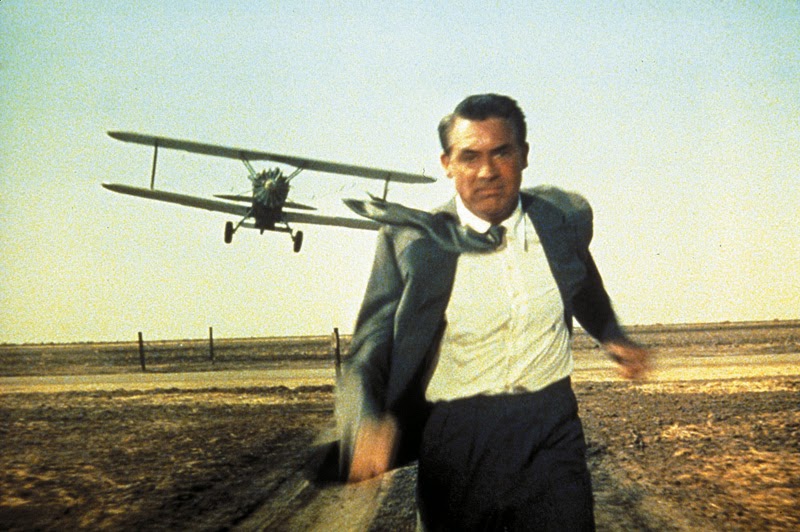
First, Roger Thornhill is a regular guy.  But he is kidnapped by bad guys and almost killed. Now the cops think he is a drunk driver and a thief, and won't believe him and do really shoddy detective work.  Roger does his own detective work but then ends up being framed for murder.  The CIA knows he's innocent and use him as a pawn against the bad guys.

ahhh a plane is chasing me!

So now Roger has to elude both the bad guys and the cops! And the government helps, but not really.  Roger goes all across the country and even gets chased by a plane with a machine gun.  Then he almost falls off of Mount Rushmore! So much is happening! More exclamation points!! I will give this film a 9/10.