Tuesday, September 15, 2015

O Pagador de Promessas (The Given Word) (1962)

Today's film is O Pagador de Promessas, which translates to "a payment for promises" and has the English title The Given Word.  The film goes to show you how stubborn men can be and the trouble it can cause.

Zé lives on a farm in Brazil.  He has traveled a very long way, 7 leagues in fact, while carrying a heavy cross on his shoulder.  His wife, Rosa, accompanies him on his journey.  They get to the church of Saint Barbara, and Zé intends to leave the cross at her altar in order to fulfill his promise.

Meanwhile, a man called "Handsome" sees them lying on the steps of the church and invites Rosa to his hotel so she can avoid the rain.  However, he is creeping on her the entire time.  I see him as mainly a character to distract her from her husband and create drama.

So, in the morning it's Saint Barbara's festival.  Zé sees the priest and tells him his story about his promise.  However, he has one fatal mistake: He talks way too much!  All he had to do was tell him that he made a promise that if his favorite donkey was healed, he would carry a cross and lay it at her altar.  That's it.  But no, no, he has to run his mouth.  He didn't make the promise in a church, he made it in a house of witchcraft, or macumba (which is an old-fashioned term for early non-Christian religions, kind of how like Santeria is practiced here).  This makes the priest all kinds of angry and he refuses to let Zé into the church.  Thus, the stubbornness stand off begins.

So is Saint Barbara and Iñasã the same person?  Technically yes.  When missionaries went to other countries, they often mixed local customs to make it easier on the people.  The best example is Brigid.  She's a Celtic goddess in Ireland.  The Christians couldn't "get rid" of her, so they declared her a Catholic saint, Saint Brigid.  Is she a real person? No, she's a goddess.  In the same way, people pray to Saint Barbara and her macumba counterpart, Iñasã, mainly against fever and illness.  It is important to know that Barbara was a martyr who died for her beliefs.  So, people like Zé can't tell the difference between them, because there isn't, while a conservative priest certainly can.


Very soon, the media takes over, and starts putting words in Zé's mouth.  The whole thing turns into a media shitstorm circus, just like Dog Day Afternoon.  The only person who sees any sort of reason is Rosa.  She tells him to take the church's offer and stop letting the press get to him, and that they should leave and go home before anything gets worse.  But, Zé is super stubborn and will not take anything for an answer until he gets his cross inside.  But we already know that's not gonna happen!

So they get the cops called on them.  The bystanders in the crowd tell them to run before they are arrested or maybe shot!  Lol, Brazilian cops are just like American cops, shoot first and ask questions later.  However, he can be easily arrested for disturbing the peace, which is what he is doing.  Anyway, cops being cops, they start a massive free for all fight which results in Zé's death.  But, absolutely no one else is hurt in the slightest.  Why?  So, the crowd gathers around him and ties his body to his cross and force their way into the church.  Zé finally did keep his promise to Saint Barbara, but he died for what he believed in.  And all of this for a donkey.  What have we learned from this?  I will give this film a 7/10.

Saturday, September 12, 2015

Ta'm e guilass (Taste of Cherry) (1997)

Today's film is Taste of Cherry, which was filmed in Iran.  The story focuses on a suicidal man, but what is interesting is how it was made.

 The man wants to kill himself for an unspecified reason.  He wants to be buried under an unspecified certain tree, he just needs someone to throw dirt on his body, and he will pay for it.  He asks three strangers to help him.  The first one is a timid soldier who runs away.  The second one is a seminarian who lectures him on the morals of his choice.  Fjnally, he finds someone who will help him.  This person attempted suicide before and shared his story with him.

So what is unique is how this was filmed.  It was more ad-libbed than scripted. The director would actually sit in either the driver or passenger seat and start up a conversation. Then the film was edited together and it looks like the two actors are talking to each other in the car.


 It ends with the main guy lying down in his makeshift grave and the scene fades to black.  Then, all if a sudden, the filmmakers appear with all their cameras and equipment. Then they film some random soldiers rolling around in the grass.  The ending is like a punch in the face surprise, like Just Kidding! It was a movie the whole time!  I will give this film a 6/10.

Wednesday, September 9, 2015

The Abominable Dr. Phibes (1971)

Today's film is The Abominable Dr. Phibes.  I love movies with Vincent Price! He can make any movie entertaining.  He knows exactly when to be funny and when to be creepy or scary.  He is everything  that Tim Burton wishes his movies could be. He tries to be cute and creepy and funny at the same time, and it never works.

 There are so many questions unanswered about this movie.  Why did Dr. Phibes use the legendary Egyptian plagues as inspiration for his murder spree? Who exactly  is the beautiful  Vulnavia? She never speaks, and is always there to assist Dr. Phibes.  What is her relationship with the doctor? Did she know his wife personally?
The weirdest part was that clockwork band. Did Dr. Phibes make that? Was he a real medical doctor? I mean he had to be to know how to do blood transfusions.  He also had a degree in art, a PhD in theology, and he was a concert pianist.  Why did it take him four years before he killed anyone, and how did he keep his wife so perfectly preserved?


I like to think of this movie as an early predecessor to Se7en.  Because that guy uses the seven deadly sins to murder people, whereas Dr. Phibes uses the plagues.  However, two of the plagues were replaced with rats and bats for visual reasons. You have to give him credit for being super creative though.

And not only that, he wins.  He always stays two steps ahead of the police, and succeeds in almost everything he sets out to do. I will give this film a 7/10.

Wednesday, September 2, 2015

A Nightmare on Elm Street (1984)

We've been on vacation for a few days to celebrate my daughter Azalea's 5th birthday.  Before we left, we all watched A Nightmare on Elm Street together as a family.  Unfortunately this coincides with the passing on Wes Craven, so we dedicate this review to him.

 So, the plot is really simple. Teenagers fall asleep and Freddy Krueger kills them in their dreams.  As I saw in the realistic documentary The Matrix, if you die in your dram, you die in real life.  My theory about this film is about this film only and does not apply to any sequels, however many there are.

I had a hard time gleaning any information  about Freddy Krueger  from this film.  The explanation from Nancy's mom seemed really quick.  If Freddy kills children, why did he wait until everyone was in high school?

 Here is my theory.  The entire film is Nancy's  dream.  The scenes of reality or dreams are simply various levels of consciousness, including  lucid dreaming near the end.  It's really obvious  when she goes to visit  her friend in jail.  Why else would she be able to see his date at the hands of Freddy and know to go there in the middle of night? Or how did she grab his hat and bring it back to the "real world"?  That's because she didn't,  it's just a dream.  Also, she keeps escaping him but no one else can.  It's apparent that it's the work of one dreamer, not multiple  teenagers doomed to die.  That's why it's called A Nightmare on Elm Street, not Multiple Nightmares by Various People. Anyway, we all enjoyed this film (mainly for all its wonderful 80's special effects), and I will give it a 7/10.

Monday, August 24, 2015

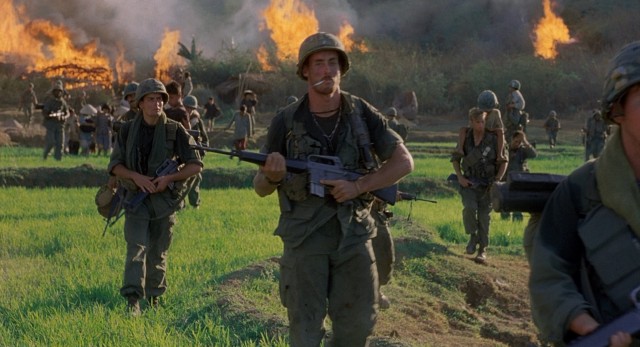
Platoon (1986)

Today's movie is Platoon.  It takes place during the Vietnam war.  The terrain was a lot different in this war than in the first two world wars.  Instead of mountains and farmland fields, there was dense jungle brush and swampland.

The main character, Chris, dropped out of college to volunteer to fight.  He learns that most people there couldn't afford college and were drafted.  They don't value him at first because he hasn't been there long.


There are a lot of stars in this film, and they all were cast outside of their type.  Charlie Sheen plays Chris, who starts out naive and sweet, and that is not like him at all.  The helpful Sgt. Elias is played by Willem Dafoe, who normally plays villains.  Sgt. Barnes who shoots everyone including people on his own side that don't agree with him, is played by Tom Berenger, who usually plays good guys.  John C. Mcginley, who usually plays asshole characters like Dr. Cox, plays Sgt. O'Neill, who is actually a nice person.  This shows that in this film, you can't judge people because they might surprise you.

The film was based on Oliver Stone's experiences during the Vietnam War, and he mainly wrote to counteract what he saw in the Green Berets, feeling that it was false.  I never saw that film so I can't comment on that.


One thing the war does is change Chris.  He starts out hopeful and wanting to help everyone.  He receives the tiniest scratch and believes that he will die.  After seeing his fellow troops massacre innocent civilians and burn down villages, his personality toughens up.  At the end, he is shooting people while covered in blood.  He tells the others that he's fine.  How will this affect him when he goes home?  Will he go back to whatever he was studying in college or do something completely different?  War changes people, and usually not for the better.  I will give this film an 8/10.

Sunday, August 23, 2015

The Chant of Jimmie Blacksmith (1978)

Today's film is The Chant of Jimmie Blacksmith.  It is based on true events.  This happened in the time of the Boer Wars (1899-1902) in which the colony of Australian was sent to fight in southern Africa to help her mother country, Great Britain.  Also at this time, Australia was seeking its independence from Great Britain.

The British settlers saw the aborigines (the original native people of the island) as a lower race not as evolved as they were.  They were given hardly any rights and were basically treated like dirt.  They did not even get the right to vote until 1962.

The film was hard to watch at times, and it is very hard to write about.  I want Jimmie to succeed, but cannot condone violence.  As a person of multiple ethnicities who is married to a Native person, we receive racism from literally every angle.  And it's not 1900 like this movie. It's 2015.  Remember when they try to convince his white wife to leave him and work for them? And she says no because she's married and they don't care about that?  Yeah I get that all the time.  I get hatred from my white side, hatred from my non-white side, and lots of hatred from my husband's family's side.

 It is an endless source of frustration that no matter what he accomplishes he will never be good enough because he's not white.


Jimmie didn't set out to start committing violent acts.  He was driven by intolerance and pure frustration.  But once he started he couldn't stop.  He had to be punished for what he did.

Notice how many people that he and his family encounter aren't racist and try to help him throughout the film.  Only the people in power - cops, wealthy ranchers, educated preacher's wives, are the ones who believe they are better than him and treat him as such.  Maybe that's how they got to be powerful because of their superior attitude towards others.  Look at all the republicans in charge of southerns states here.  I could go on, but there's no way Jimmie could have survived in his own environment or ours.  Nothing has changed.  I will give this film a 7/10.

Friday, August 21, 2015

Sedmikrásky (Daisies) (1966)

Today's film is Daisies.  I loved this film! It was hilarious!

The film takes place in Cold War-era Czechoslovakia.  Two girls, both named Marie, decide to be bad and do generally naughty and mischievous things.  The film is overall wacky.


Most of the film, the two white girls stuff themselves with food, especially whipped cream topped desserts, and hit on older men.  I really identify with that and therefore this film speaks to me on a spiritual level.

There's so much cool stuff going on.  Camera tricks, editing tricks.  Marie cuts off other Marie's head and her disembodied head floats around laughing at her.  The colors of the scene change often.  This is like a visual, constantly moving art piece.

Another important scene is where the two Maries cut up a bunch of phallic shaped foods into pieces with their scissors.  I'm sure this is very symbolic of the feminist nature of the film.  Also, they cut out magazine pictures and eat them.


The Maries end up eating and destroying an entire banquet.  They feel bad about this, so they try to clean up, only to have the chandelier land on them!  They also question if they even exist.  How does one prove that?  This film is so artistic and so much fun.  However, it is not a long film.  That is because film production had to be halted because everyone was arrested for wasting food.  Oh, well that is communism for you.  I will give this film a 8/10.